Practices
Six practices. One platform job: build, operate, secure, and run to a cost.
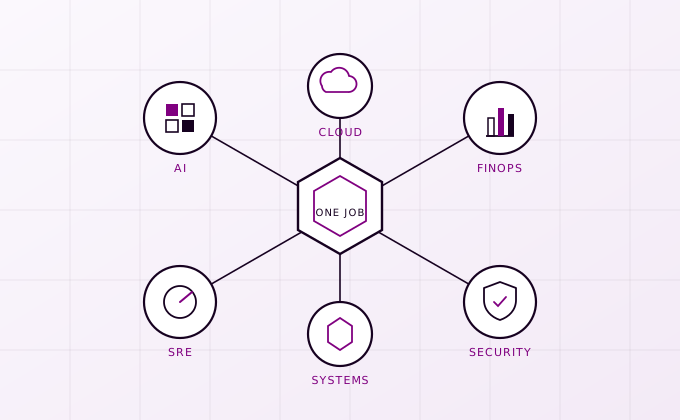
Vilwave does not sell six consultancies. AI, cloud, FinOps, SRE, distributed systems, and security are how one production platform is designed and run. The practice is shaped by production environments in automotive, insurance, finance, and telecommunications.
Talk to usGPU, serving, and data paths for production AI — not demos.
Learn moreSystems that scale and fail safely — Kubernetes, pipelines, topologies.
Learn moreProof
The practice is shaped by production systems in these sectors.
AI Infrastructure Engineering, Cloud Engineering, FinOps, Site Reliability Engineering, Distributed Systems Engineering, and Security. We treat them as one platform job: build, operate, secure, and run to a cost.
No. The six names are how we see one production platform, not six mandatory workstreams. A diagnostic or a scoped build can be one practice — FinOps, SRE, a landing zone, security on the platform — as long as we are not pretending the rest of the environment does not exist. What we will not sell is six disconnected consultancies on the same stack.
Yes. We start from what you already run — cloud accounts, Kubernetes, data paths, GPU or serving stacks — then design the next step around your constraints, not a greenfield template.
Platforms that stay up, stay locked down, and stay within budget. You get engineering delivery plus the operating model — SRE, security, and FinOps — so the work does not fall over after go-live.
Security is designed into the platform: identity, secrets, network path, supply chain, and data boundaries for AI and distributed workloads. We work to industry practice and treat client environments as production from day one.
Yes. Cloud engineering covers landing zones, migration, hybrid paths, and the paved road so teams can ship without reinventing the platform each time.
Clear scope, named owners, and regular checkpoints. Engagements are typically a diagnostic, a scoped build, then an operate retainer — not an open-ended software project with no operator.
Site Reliability Engineering includes on-call and incident response when that is in scope. We agree SLOs and support hours up front so production is covered, not hoped for.
Contact us through the website. We start with a short consultation to understand the workload, the bill, and the reliability risk — then propose a diagnostic or a scoped engagement.
A diagnostic typically takes two to three weeks. Build timelines follow a written scope. We will not quote a go-live date before we have seen the environment and agreed what “done” means.
Architecture, cost, and reliability decisions are made with you, not after the fact. You see progress against the scope, not a surprise at the end.
What is failing, costing too much, or blocking AI in production. Which cloud you are on, and whether reliability, security, or the bill is the urgent problem. A clear constraint is more useful than a wish list.
It depends on scope, duration, and whether the work is a diagnostic, a build, or an operate retainer. Pricing can be fixed fee, time-based, or a mix. We are precise once we have seen the problem.
You can keep us on to operate: SRE, security on the platform, and ongoing FinOps. We know the system because we built it — and production is where the value is. Operate is a written retainer with hours and support boundaries, not an open-ended promise.